

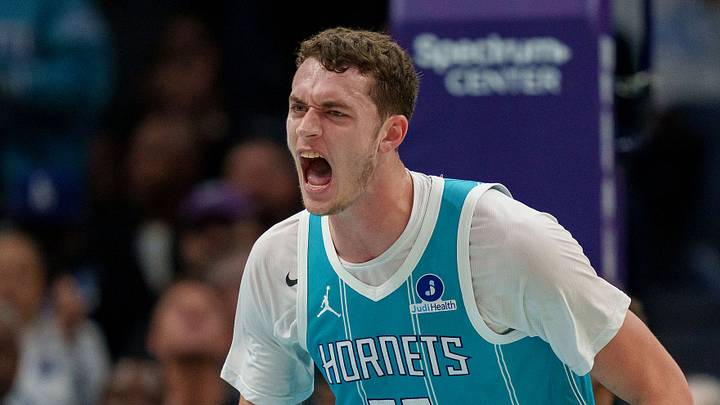
The Charlotte Hornets have a surplus of quality big men competing for a scarce few spots in the rotation. Naz Reid is safe as the starting power forward, but the likes of Moussa Diabate, Ryan Kalkbrenner, and Hannes Steinbach are all fighting for minutes. It’s still early, but Kalkbrenner is pulling ahead by a noteworthy distance.
Though Kalkbrenner may be the player who has received the least fanfare in that group, he’s anchoring the interior and providing stability the Hornets can’t continue to ignore.
Charlotte is riding high off of a 124-112 upset of the Cleveland Cavaliers that snapped a six-game losing streak and brought the offense back to life. Despite playing without Kon Knueppel, Brandon Miller, and Dennis Schröder, the Hornets scored their most points all season and recovered from scoring fewer than 100 points in four of their past six outings.
Kalkbrenner played a direct role in the team’s success, recording eight points, 15 rebounds, 10 offensive boards, three assists, three blocks, and a steal in 35 minutes.
Kalkbrenner’s dominance on the offensive glass and general control of the paint helped Charlotte overcome the All-Star interior duo of Jarrett Allen and Evan Mobley. More importantly, it showed the Hornets how the on/off numbers that Kalkbrenner has amassed through 11 games are worth valuing and perhaps even prioritizing when crafting the ideal starting lineup.
Diabate and Steinbach are compelling players with merits of their own, but Kalkbrenner is the Hornets’ best option for the starting center role as they look to turn their season around.
Ryan Kalkbrenner’s interior dominance vs. Cavs isn’t surprising
Charlotte is currently recording its best net rating when Kalkbrenner is on the court at +7.6. The context includes the fact that he’s appeared in all 11 games, has played over 200 minutes, and is the only player on the roster who has produced a positive net rating at this stage of the season.
In 321 minutes without Kalkbrenner on the court, the Hornets are posting a net rating of -22.9—the lowest mark on the team. That’s a swing of 30.5 points per 100 possessions.
One of the primary reasons that Kalkbrenner's made such a powerful impact on Charlotte as a team is that he's making the individuals around him better. Naz Reid, for instance, increases his production by 3.8 points, 3.6 rebounds, and 2.0 assists per 36 minutes while shooting 4.5 percent better from the field and 5.3 percent better from beyond the arc when Kalkbrenner is on the court.
Brandon Miller has been an even bigger beneficiary, averaging 11.2 more points per 36 minutes while shooting 12.7 percent better from the field and 13.2 percent better from three-point range.
Ryan Kalkbrenner is making the players around him better
Considering Miller and Reid are the Hornets' leading scorers, Kalkbrenner's direct impact on their success shouldn't be downplayed. Instead, it should be highlighted—especially when Miller is shooting just 31.4 percent from the field in 209 minutes without Kalkbrenner and 44.1 percent in 101 minutes with him.
Furthermore, Grayson Allen is mirroring Miller and Reid's success by averaging 9.2 more points per 36 minutes while shooting 13.6 percent better from the field and 14.9 percent better from beyond the arc with Kalkbrenner on the court. Sion James is shooting 35.3 percent from beyond the arc when Kalkbrenner is on the floor and 22.9 percent when he isn't.
Throw in Royce O'Neale with a jump of 10.0 percent from beyond the arc and six of the top seven players on the team in minutes per game are surging in efficiency with Kalkbrenner. The only exception is Diabate, whom Kalkbrenner would start over.
Kon Knueppel and Coby White have unfortunately been plagued by injuries, but based on how Kalkbrenner has helped virtually everyone else, he deserves a chance to start and prove himself once they're back at 100 percent.
Ryan Kalkbrenner simplifies the game on both ends of the floor
This all leads to a pivotal question: What exactly is Kalkbrenner doing to fuel these changes? For one, opponents are shooting 13.1 percent worse than average within six feet of the rim when Kalkbrenner is the primary defender. His averages of 1.3 blocks per game and 2.4 per 36 minutes don't hurt, either.
Offensively, Kalkbrenner is an active screener generating 8.0 screen assist points per 36 minutes for a Hornets team that ranks dead last in offensive rating.
Kalkbrenner is also pulling down 5.9 offensive rebounds per 36 minutes and dishing out 3.0 assists per 36. Beyond the numbers, he's a player who doesn't need the ball to make an impact. That's helped the players around him operate with more confidence, all the while benefiting from his passing, rebounding, and screening.
When all else fails, it doesn't hurt to have a 7'1" and 256-pound big anchoring the interior—particularly for a fairly perimeter-oriented team.
Moving forward, all of this should add up to Kalkbrenner getting the nod for the starting job at center. Diabate had an excellent 2025-26 campaign and may still turn things around in 2026-27, but the Hornets can't ignore how Kalkbrenner is making those around him better.
With Reid and Kalkbrenner anchoring the interior and the Hornets' perimeter hopefully returning to full strength soon, they may just turn the season around after a 4-7 start.
 Add us as a preferred source on Google