

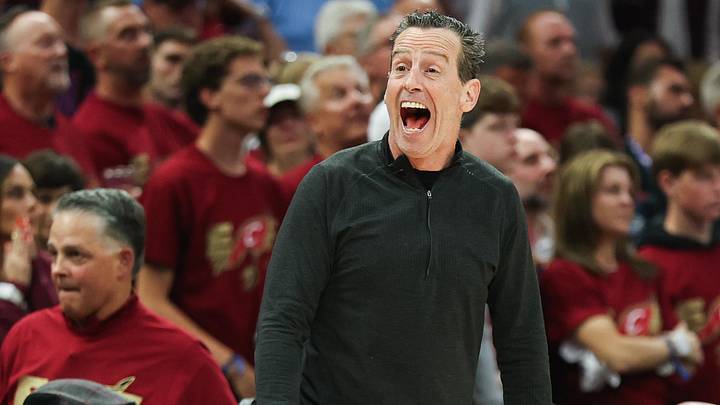
The Charlotte Hornets were, in several analytical metrics, legitimately better than the Cleveland Cavaliers. Yes, the comparison is tongue‑in‑cheek, but the numbers don’t lie: Charlotte outperformed Kenny Atkinson’s squad in point differential and a handful of other meaningful categories.
Meanwhile, the Cavaliers, who are fresh off a stunning sweep at the hands of the Knicks in the Eastern Conference Finals—are reportedly doubling down on James Harden and sticking with Atkinson. While it looks like they may be keeping most of their core, it’s fair to wonder if one of their starters will be on the trade block.
That contrast makes it the perfect moment to highlight just how impressive Charlotte quietly became.
Charlotte’s point differential puts them in elite company
The Hornets finished with the fourth‑best point differential (+4.8) in the Eastern Conference, trailing only New York, Boston, and Detroit. Point differential is widely considered one of the strongest predictors of future success, and Charlotte’s placement among the conference’s elite is no small feat.
Their record didn’t fully reflect that strength because their surge came late. Early in the season, the Hornets were derailed by injuries to Brandon Miller and LaMelo Ball, and head coach Charles Lee was still experimenting with rotations while trying to coach up a shaky defense. The result: a rough 4–14 start.
Once healthy and settled, Charlotte took off and delivered one of the most dramatic turnarounds in franchise history. They closed the season 44–38 and secured a play‑in berth.
The underlying numbers suggest that run wasn’t a fluke. Even compared to a conference finalist like Cleveland, Charlotte’s point differential paints a picture of a team with sustainable, scalable dominance.
Charlotte quietly won several other key metrics
Beyond point differential, the Hornets also posted a stronger offensive rating, better three‑point shooting, and superior offensive rebounding. Sure, this involves a bit of cherry-picking as Cleveland excelled in plenty of areas, but offensive rating and point differential are two categories you can’t hide from.
Together, they reinforce a simple truth: Charlotte is a legitimately good team. With a few refinements, they have the tools to compete with the East’s upper echelon.
And it’s hard not to wonder how different things might look had Atkinson not backed out of his agreement to become Charlotte’s head coach. In hindsight, though, Charles Lee may have been the better sliding‑doors outcome.
Maybe the Hornets don’t draft rookie sensation Kon Knueppel. Maybe the entire vibe shifts.
Charlotte’s late‑season surge, strong analytics profile, and young core all point toward a franchise on the rise. The numbers back it up, the eye test backs it up, and the momentum backs it up.
 Add us as a preferred source on Google