

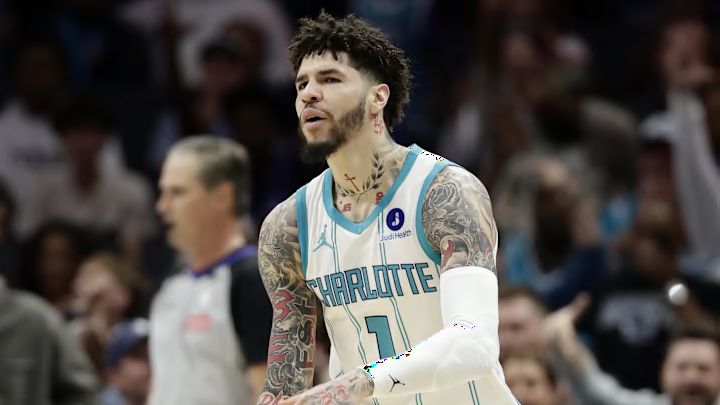
The Charlotte Hornets saw their five‑game winning streak snapped Saturday night against the Philadelphia 76ers. LaMelo Ball’s late-game shot‑making from deep kept Charlotte within striking distance in the fourth quarter, but his overall inconsistency from beyond the arc ultimately proved costly — which is a double-edged sword.
Ball finished with 20 points, three rebounds, and eight assists, but his efficiency never found its rhythm. He shot 7‑for‑26 from the field (26.9 percent) and 5‑for‑18 from three (27.8 percent). When a player takes more than a quarter of the team’s total shot attempts but converts only a fraction of them, it places a natural cap on the offense. Those empty possessions add up, and the scoring load that comes with such a high usage rate becomes harder to sustain.
Ball thrives in Hornets’ offensive system
Charlotte remains one of the league’s stronger rebounding teams, and the area most relevant to LaMelo Ball’s shot profile is offensive rebounding. The Hornets rank inside the NBA’s top ten in offensive boards per game, which gives Ball more freedom to take those ambitious, deep threes. When the team is cleaning up misses at a high rate, those missed shots become far less punishing.
When Ball catches fire, that cushion often turns into 20‑point blowouts. Last night, Charlotte grabbed an outrageous 21 offensive rebounds, with Moussa Diabate setting the tone through his usual relentless work on the glass.
Those extra possessions are typically what help the Hornets survive cold stretches. More often than not, a second‑chance opportunity leads to a cleaner look and a made shot. Ball’s presence leads to ample floor space for teammates. This time, though, even with all the extra chances, Charlotte couldn’t convert enough of them into points, and the game slipped away.
Limitations to the machine?
There’s only so much you can do to cover up inefficiency. If those second‑chance opportunities aren’t being converted into points, the result doesn’t change. Charlotte shot just 38 percent from the field last night, weighed down heavily by cold shooting from both Ball and Knueppel.
Despite what some might assume, Ball is an elite shot‑maker. He shouldn’t be lumped in with traditional catch‑and‑shoot specialists during comparisons because his offensive workload is far more diverse. Hitting over 40 percent on corner threes is very different from what Ball does. Being able to create off the dribble and knock down unorthodox, one‑legged step‑back threes is a rare skill.
Even on an off night, Ball’s fourth‑quarter surge nearly flipped the game. He buried three deep threes in a matter of minutes, giving Charlotte a real chance to steal a win. Very few players have the confidence and sheer audacity to keep firing after struggling throughout the game.
In a seven-game series, you’re likely to have an off-shooting night or two from your star player. However, Ball has shown over the last ten games that he can string together efficient performances that elevate the entire roster.
The Hornets have already secured a play‑in spot and are pushing to climb even higher, with the sixth seed still in sight. The truth is simple: even with the occasional drawback, Charlotte isn’t anywhere near this position without Ball’s elite shot‑making and overall impact.
 Add us as a preferred source on Google